
Last updated September 23, 2026
Whole-system duct and dryer vent check with before-and-after photos - you see exactly what came out of your vents
That "$99 whole-house special" is a bait ad - the real number appears once they are in your hallway, or the "clean" is a shop-vac at the register. We photograph the inside of your ducts before and after instead.
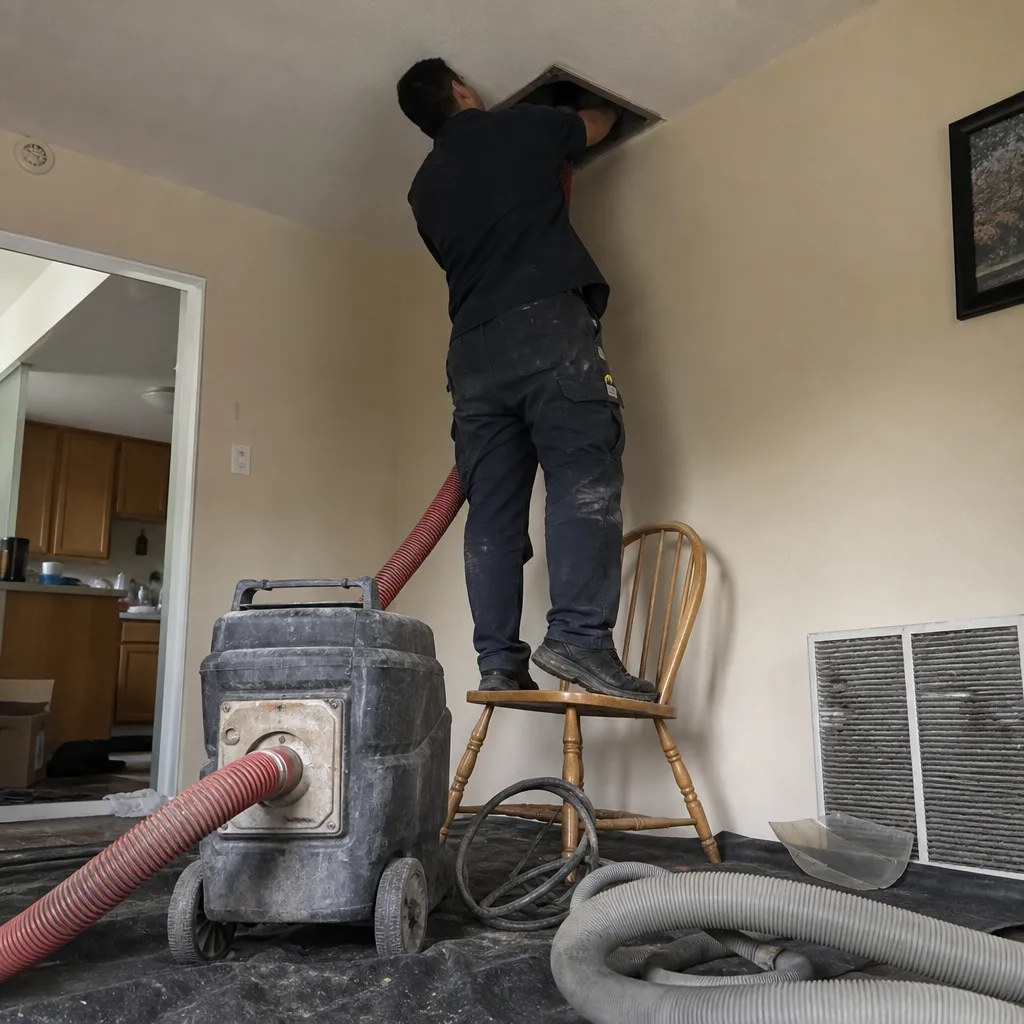 Before
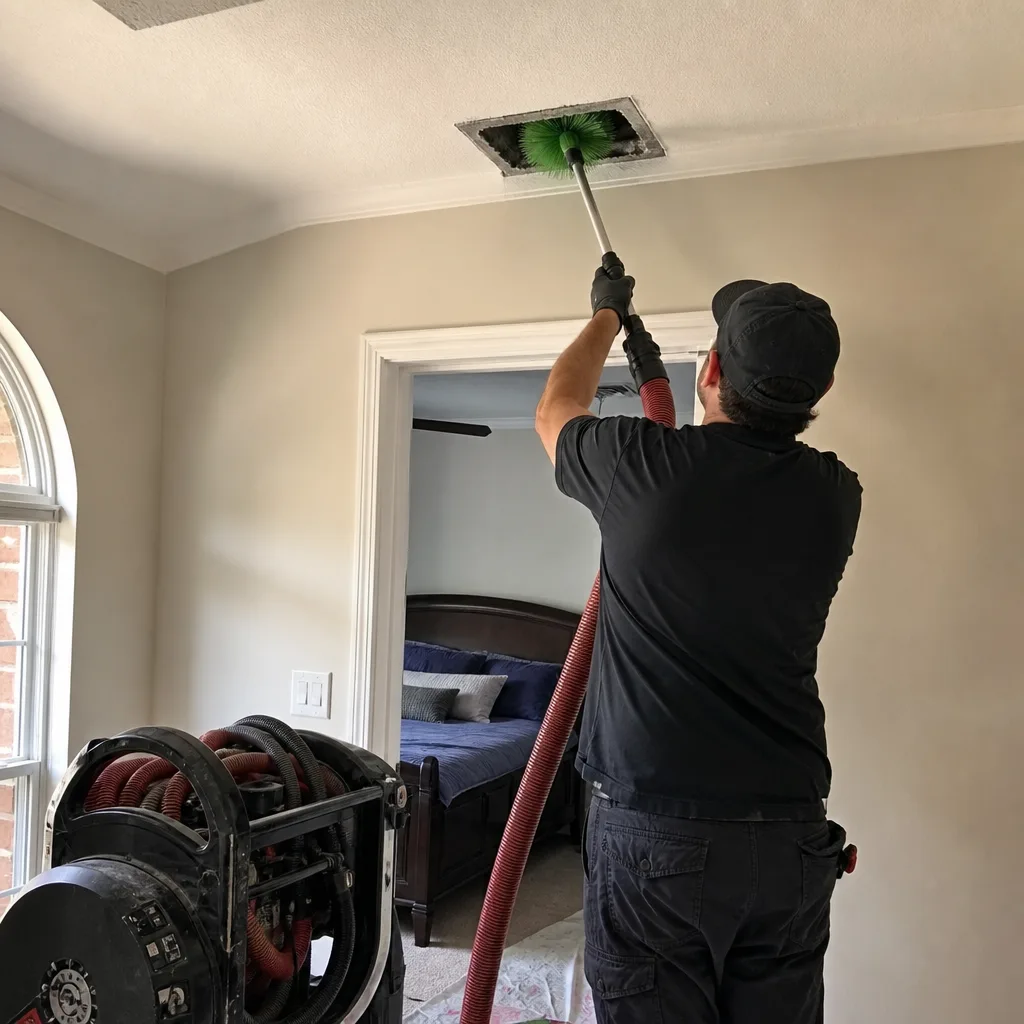 After
After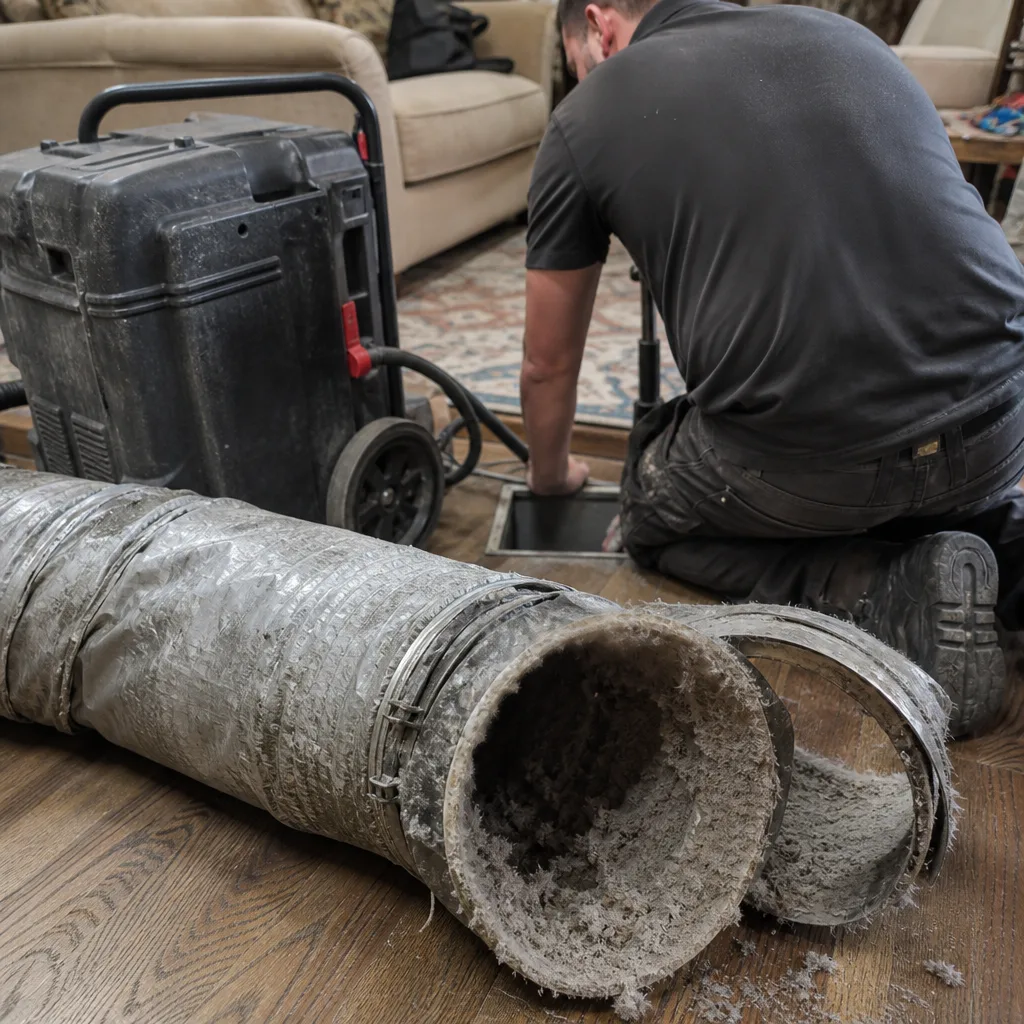 Before
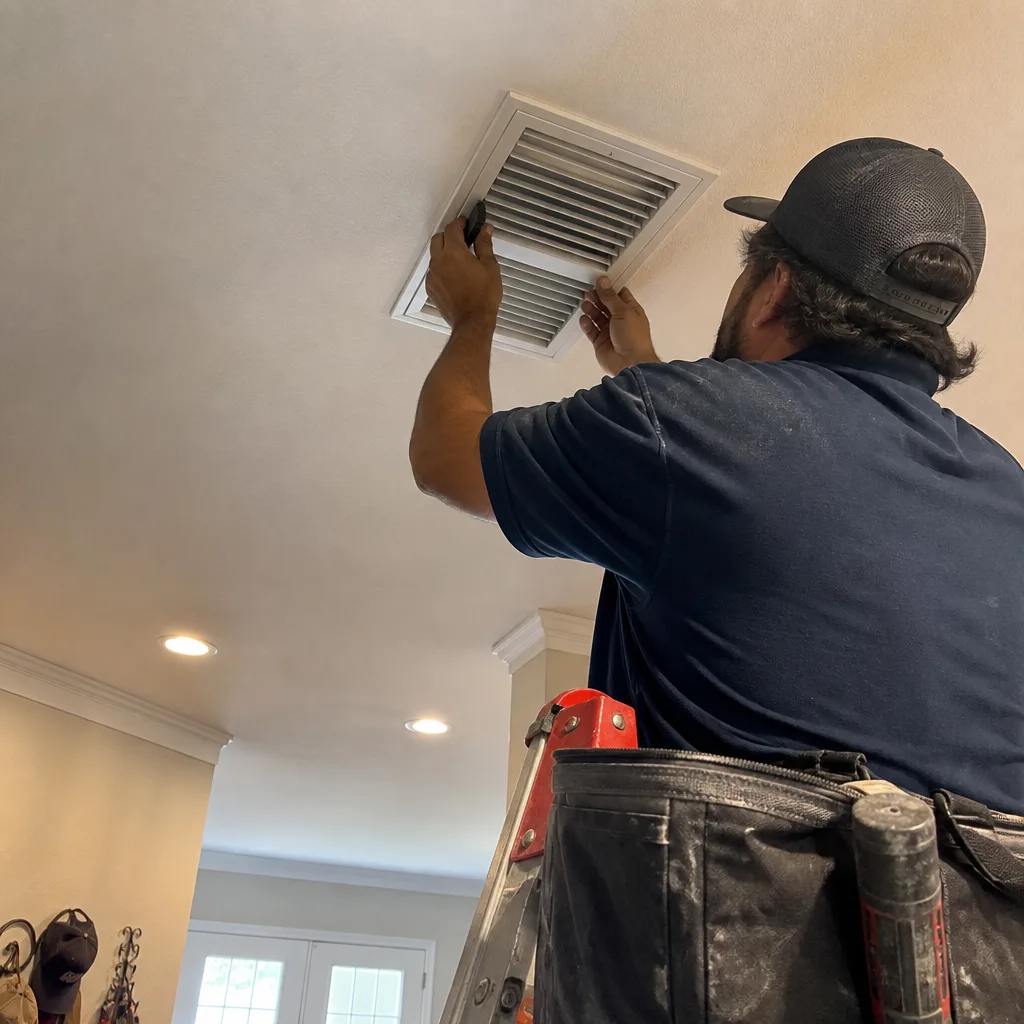 After
After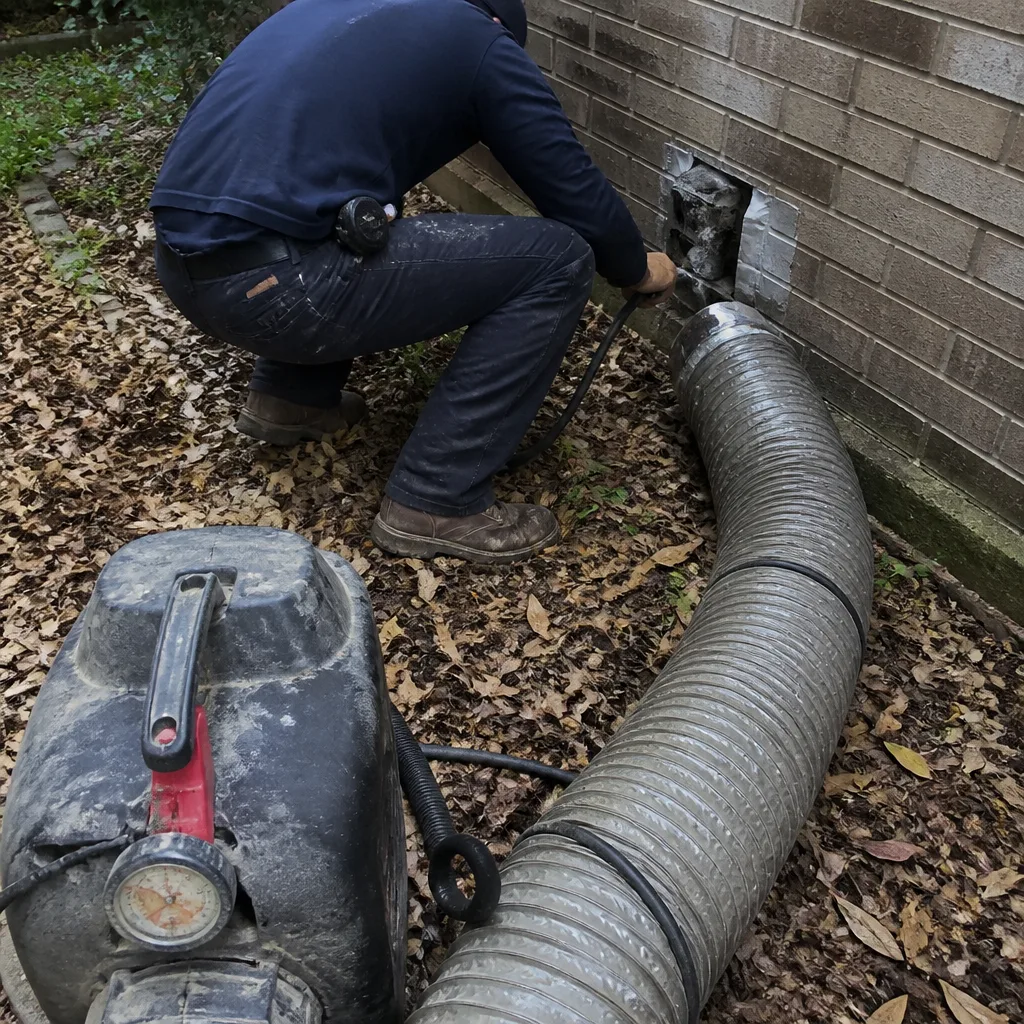 Before
 After
AfterDIY vs Professional Air Duct Cleaning: The The Woodlands Homeowner’s Decision Guide
The $89 dryer vent cleaning kit on Amazon works. The $89 duct cleaning kit does not. Here’s why: duct cleaning requires air to move toward the vacuum, not away from it, and no consumer device creates the negative pressure to pull debris through 40 feet of flex duct. In The Woodlands, where summer humidity pushes 90% and homes in Panther Creek, Sterling Ridge, and Alden Bridge were built with increasingly complex HVAC configurations between 2015 and 2025, we’ve documented thousands of systems where DIY attempts pushed debris deeper into the plenum, the main distribution box where all duct runs connect. This guide draws the exact line between what you can legitimately handle yourself and what requires professional negative-pressure extraction equipment.
Quick Answer
DIY air duct cleaning is limited to the first 18 inches of each register boot, filter maintenance, and dryer vent cleaning with a proper rotary brush kit. Anything beyond that, including full duct run extraction, requires negative-pressure source removal equipment that creates sufficient airflow to carry debris out of the system rather than redistribute it. For The Woodlands homeowners, Air Duct Cleaning services from a licensed provider typically range from $400 to $700 for a single-system home and include photographic proof of every duct run before and after.
Table of Contents
- What DIY Can Actually Accomplish (and Where It Stops)
- Why Negative-Pressure Source Removal Is the Entire Mechanism
- The Honest Cost Comparison: DIY Attempt vs. Documented Professional Cleaning
- The Two Scenarios Where DIY Is the Right Answer
- The Four Scenarios Where DIY Makes the Problem Worse
- A Documented Self-Inspection Process Before You Call Anyone
- What Professional Air Duct Cleaning in The Woodlands Actually Includes
- How to Choose a Contractor Without Getting Sold
BeforeAfterWhat DIY Can Actually Accomplish (and Where It Stops)
Let’s be precise about what “DIY air duct cleaning” means. We’ve been inside enough The Woodlands homes, from the mature oaks of Grogan’s Mill to the newer construction in Creekside Park, to know what homeowners have already tried before calling us.
Here’s what you can actually do effectively with consumer equipment:
- Register boot wipe-down. Remove the floor or ceiling register, vacuum the visible sheet metal boot, the angled transition piece connecting your duct run to the room, and wipe reachable surfaces with a damp microfiber cloth. This addresses settled dust in the first 12 to 18 inches. It does not reach the duct run itself.
- Filter replacement and tracking. Replace your HVAC filter every 60 to 90 days in The Woodlands, where pollen counts spike in March and October and the cooling season runs eight months. Write the install date on the filter frame with a Sharpie. Photograph the loaded filter before replacement. This single practice reduces duct debris accumulation more than any DIY cleaning attempt.
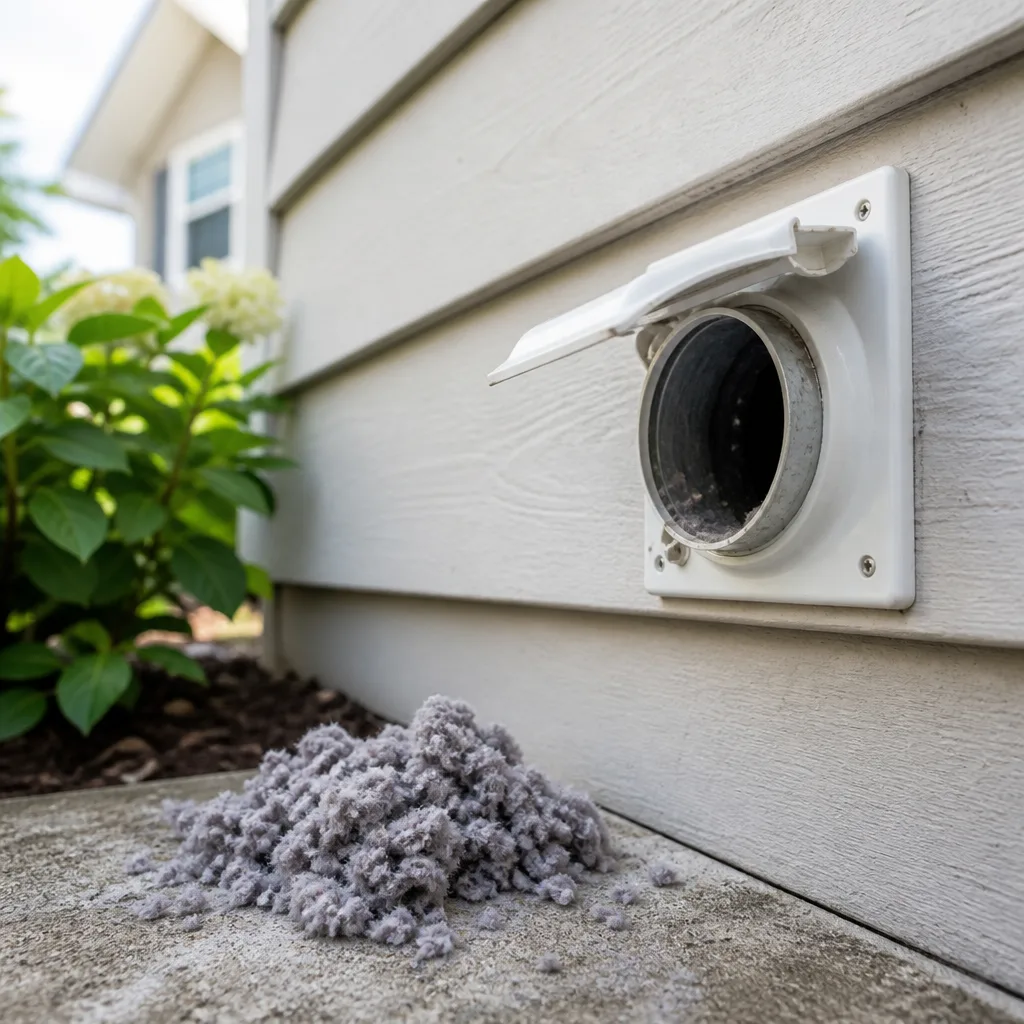
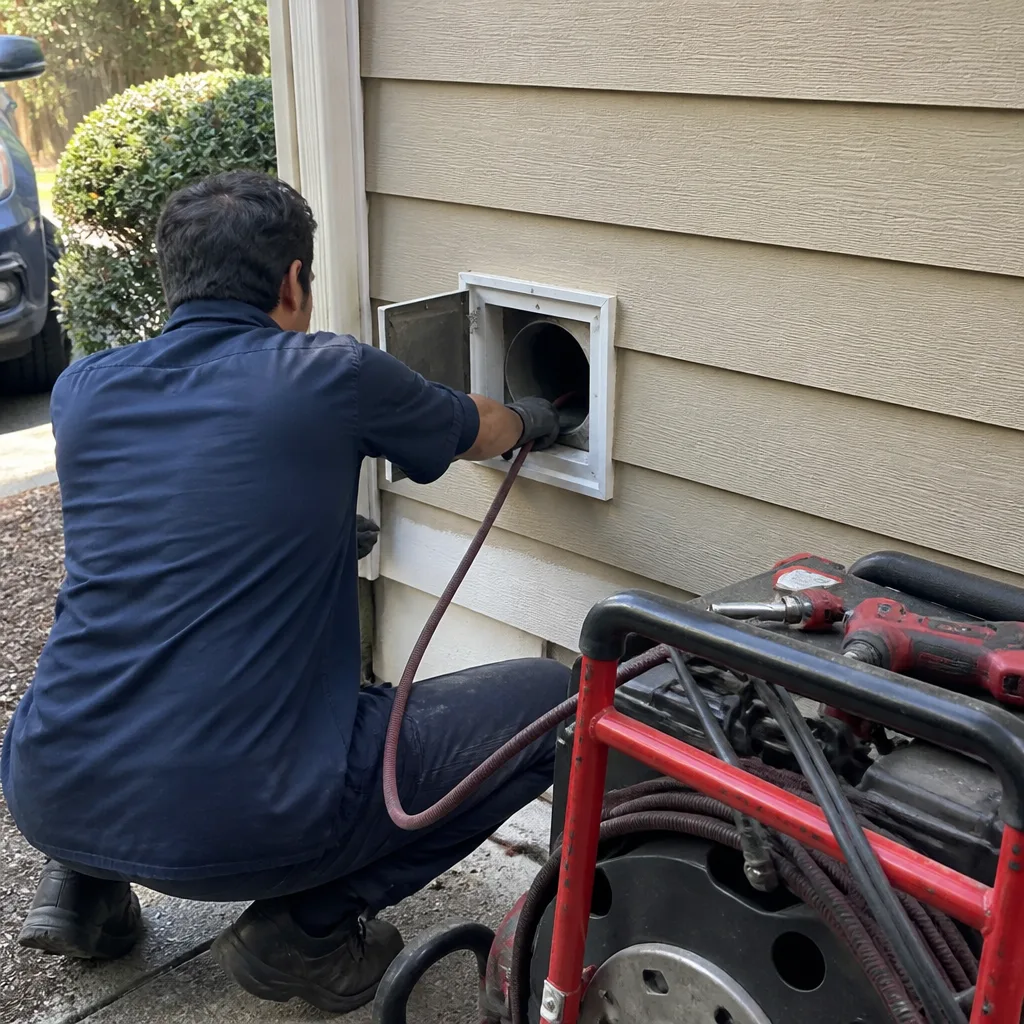
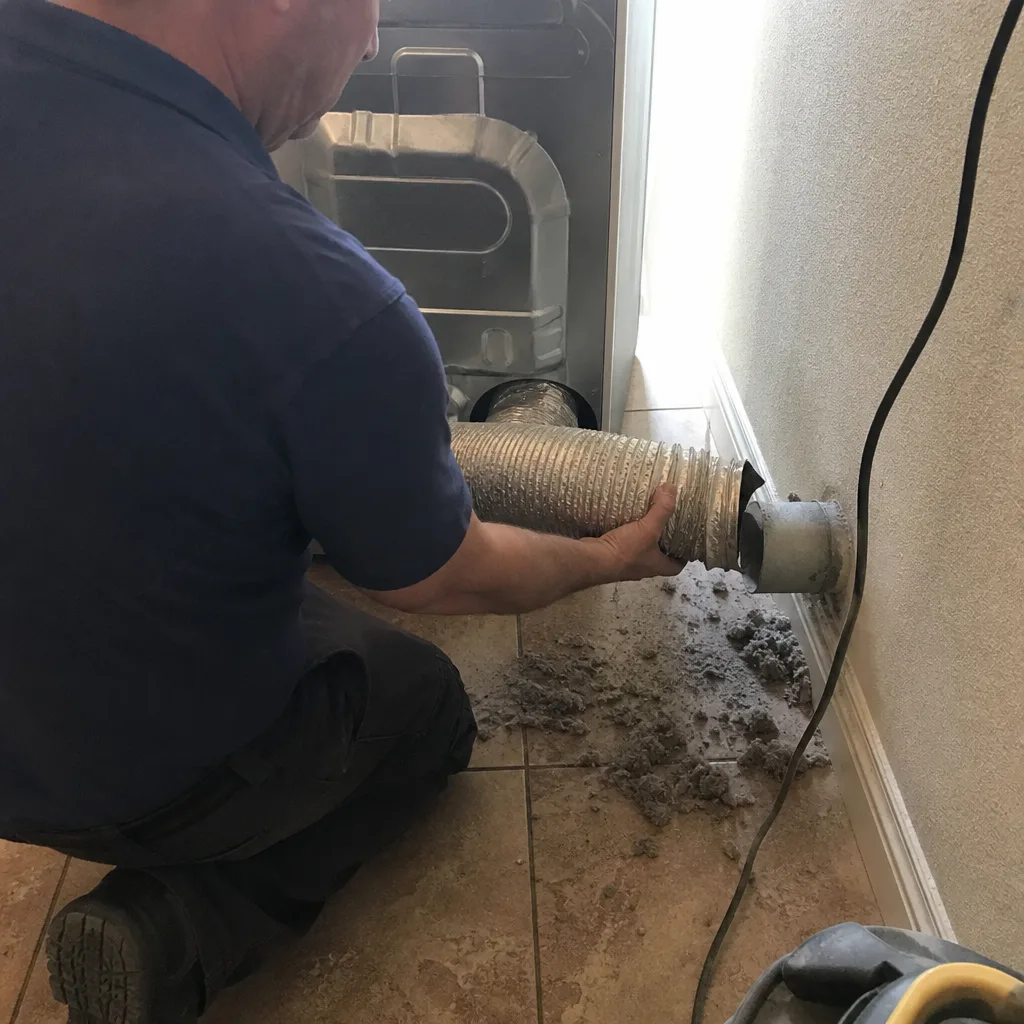
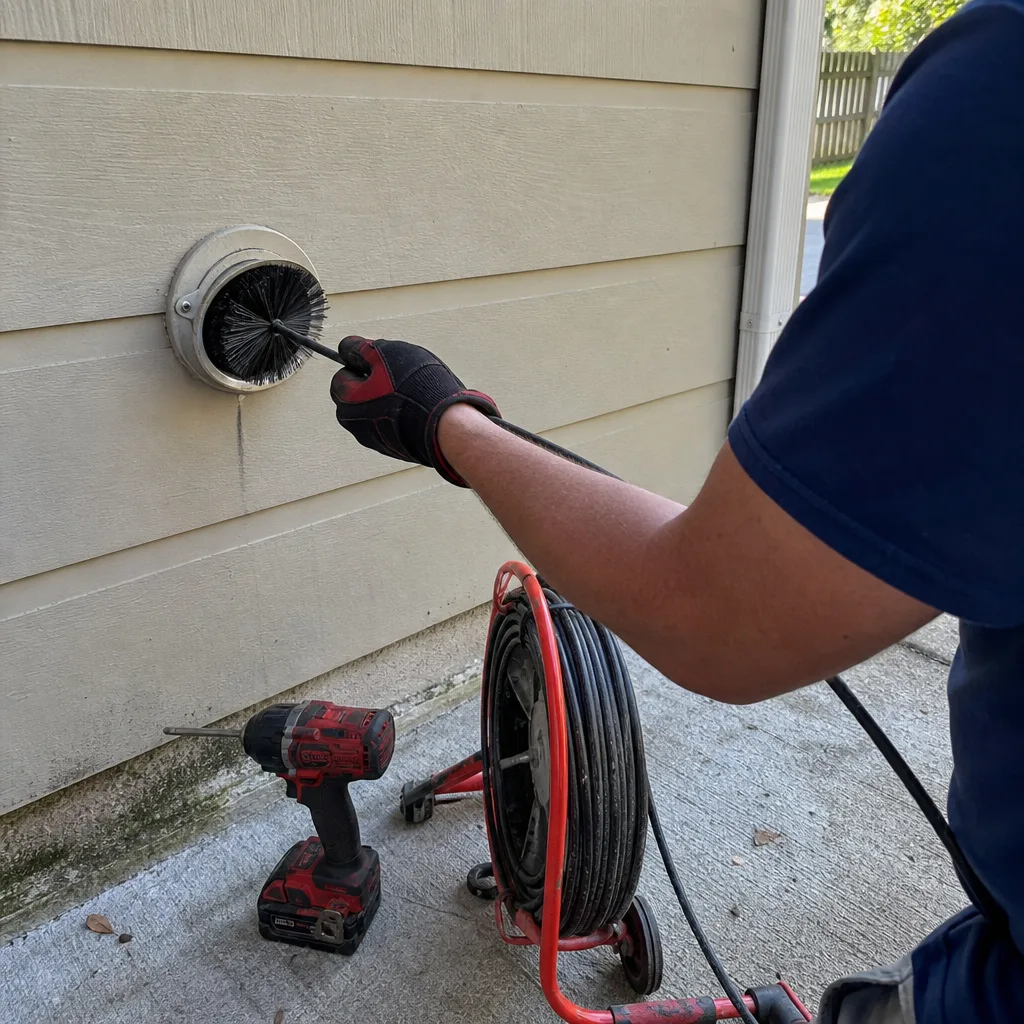
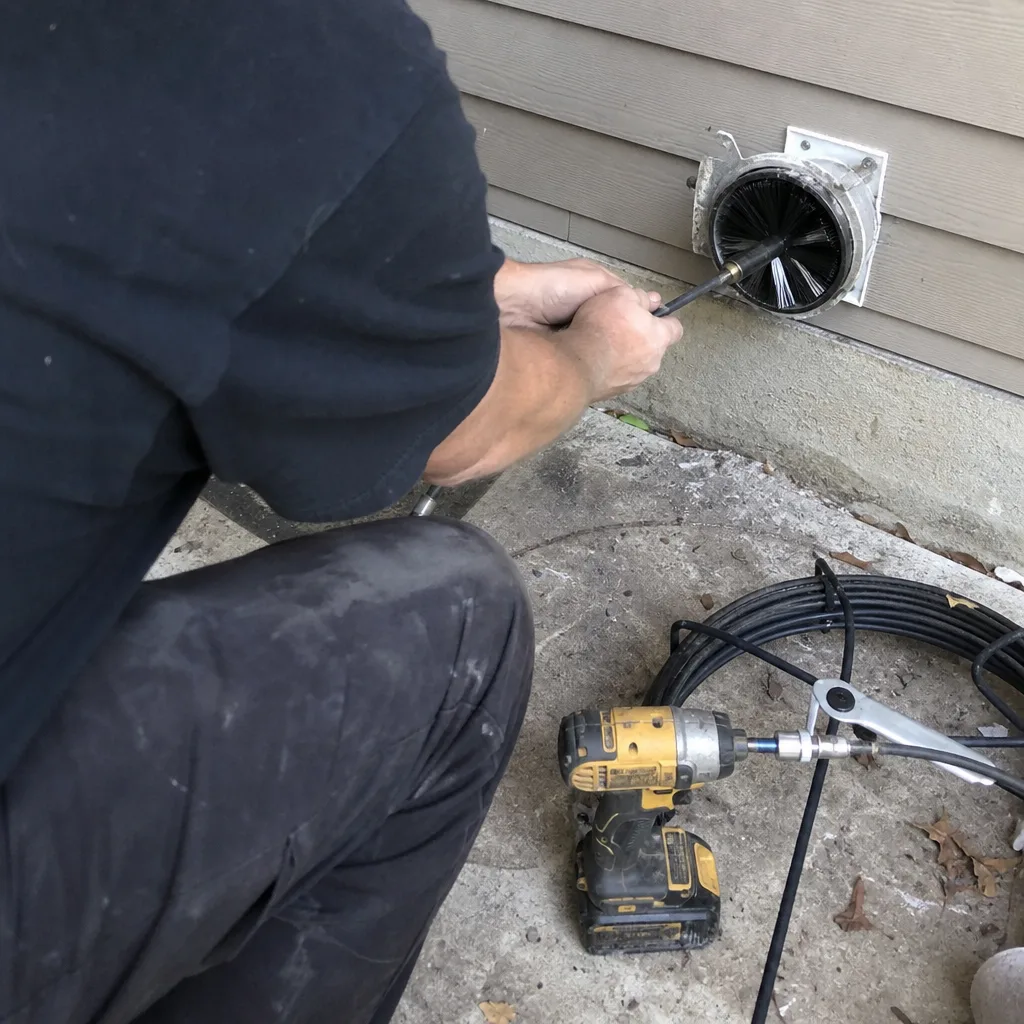
- Dryer vent cleaning with a rotary brush kit. This is the exception. A proper dryer vent cleaning kit, the one with the flexible rods and spinning brush that attaches to a drill, effectively removes lint from the transition duct and exterior vent termination. The mechanism works because lint is lightweight and the vent run is relatively short, typically under 25 feet. This is not duct cleaning, but it’s legitimate maintenance you can perform.
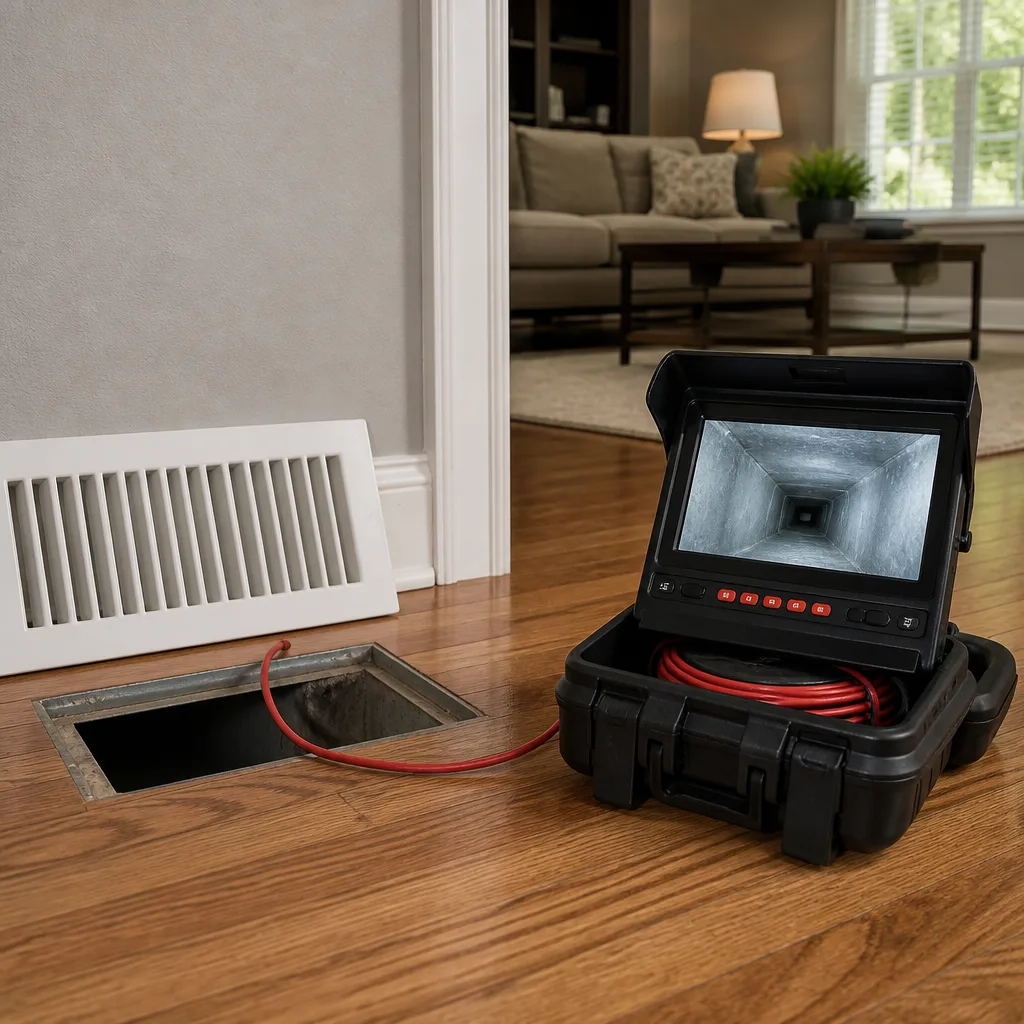
- Visual inspection with a phone camera. Extend your phone into the boot with the flash on and record video as you pan. You’ll see the first elbow, the bend where horizontal duct turns vertical or vice versa, and any obvious debris accumulation or disconnected sections. Save these videos with date stamps.
Where DIY stops: at the duct run, the actual supply or return pathway between the plenum and the boot. Consumer vacuums generate approximately 50 to 100 cubic feet per minute, CFM, of airflow. Professional negative-pressure systems operate at 2,000 to 5,000 CFM. A shop-vac at a register creates positive pressure in the immediate area, pushing debris past the first elbow and deeper into the system, where it settles in low-velocity zones and becomes harder to extract later.
We’ve documented this exact scenario in The Woodlands homes near Lake Woodlands, where homeowners ran a vacuum hose 6 feet into a return duct and compacted a decade of dust into a dense mat at the plenum connection. The camera showed a 3-inch debris build-up at the first elbow that wasn’t there before the DIY attempt. Extraction required disassembly.
Why Negative-Pressure Source Removal Is the Entire Mechanism
The direction of airflow during cleaning is not a detail. It is the entire mechanism.
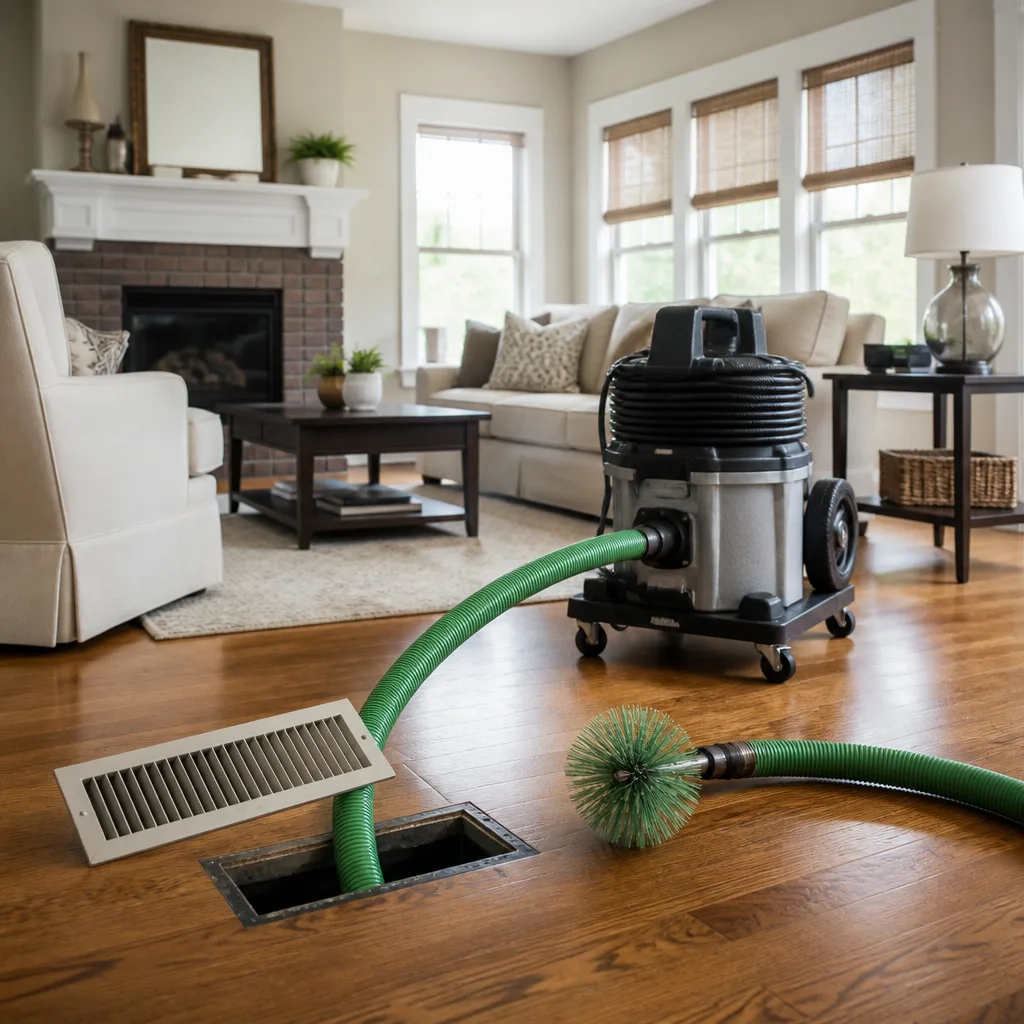
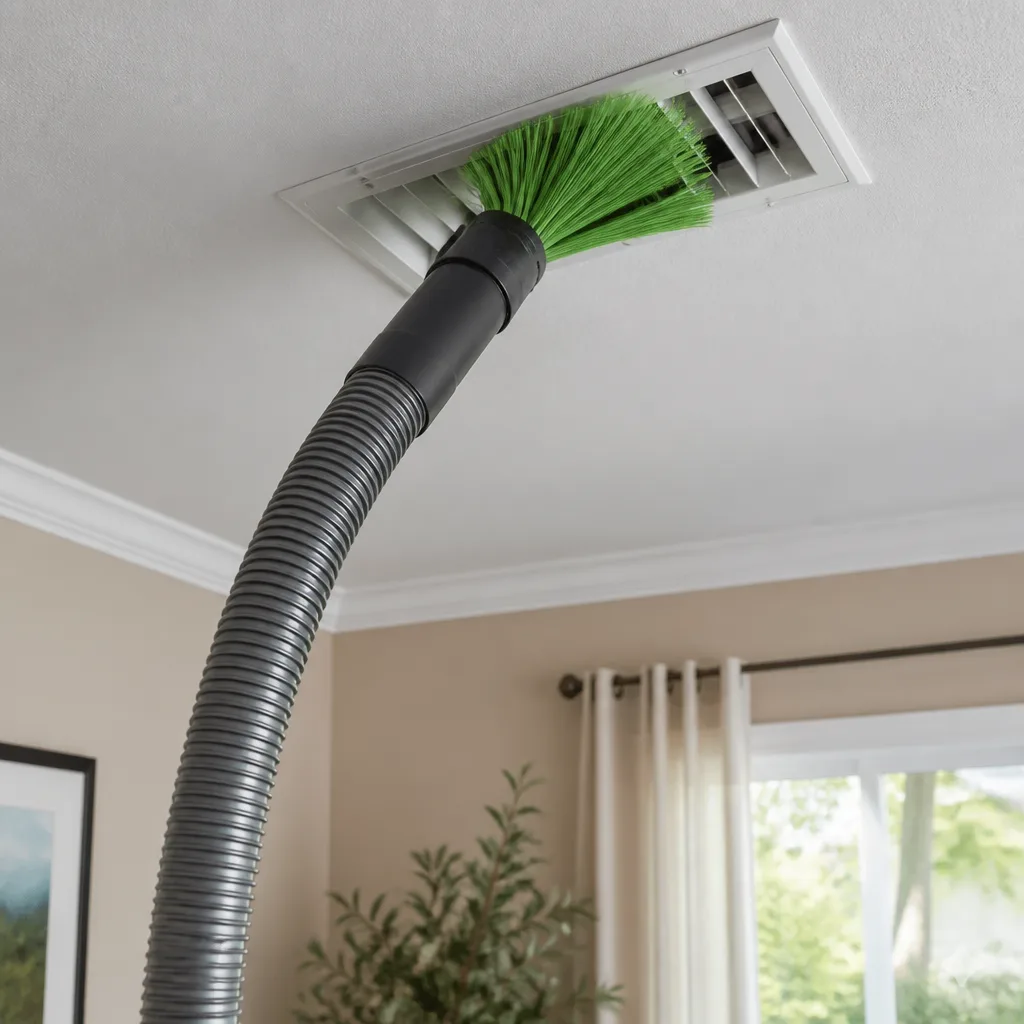
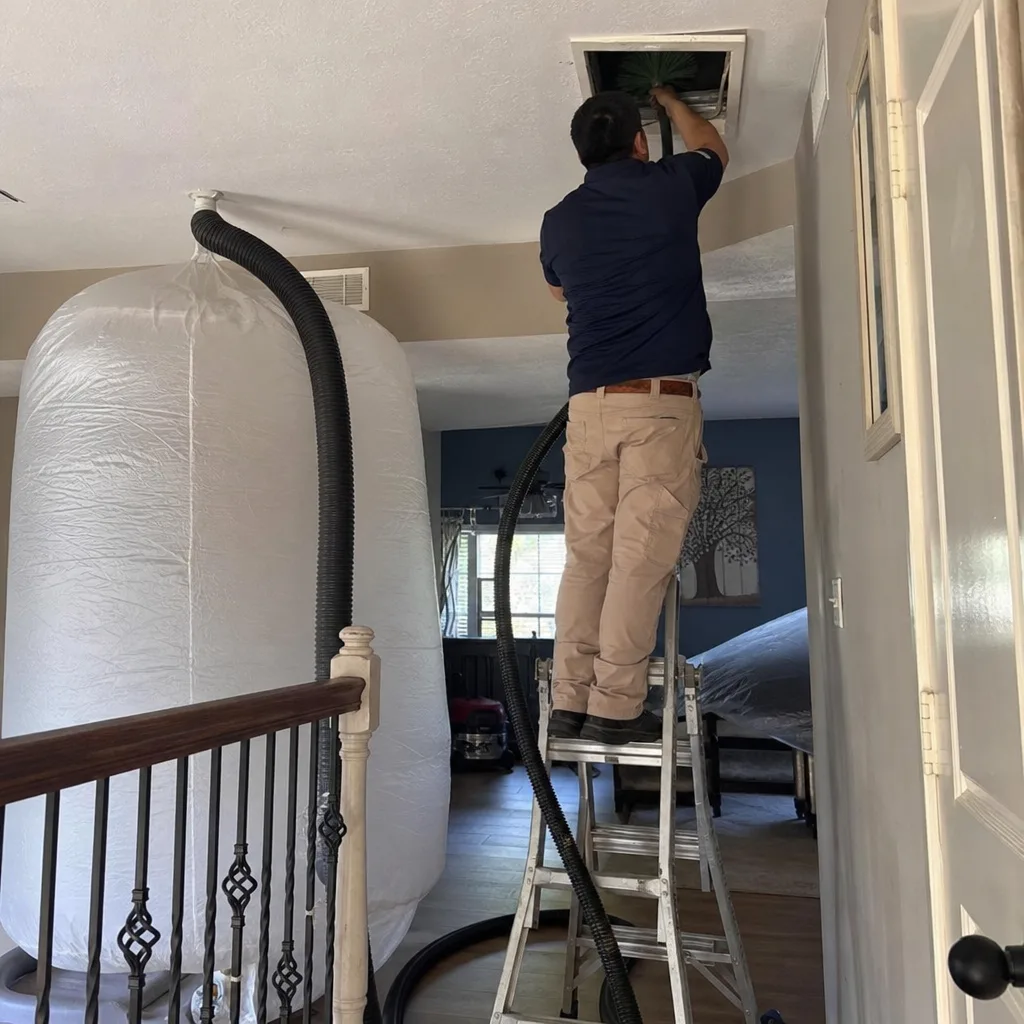
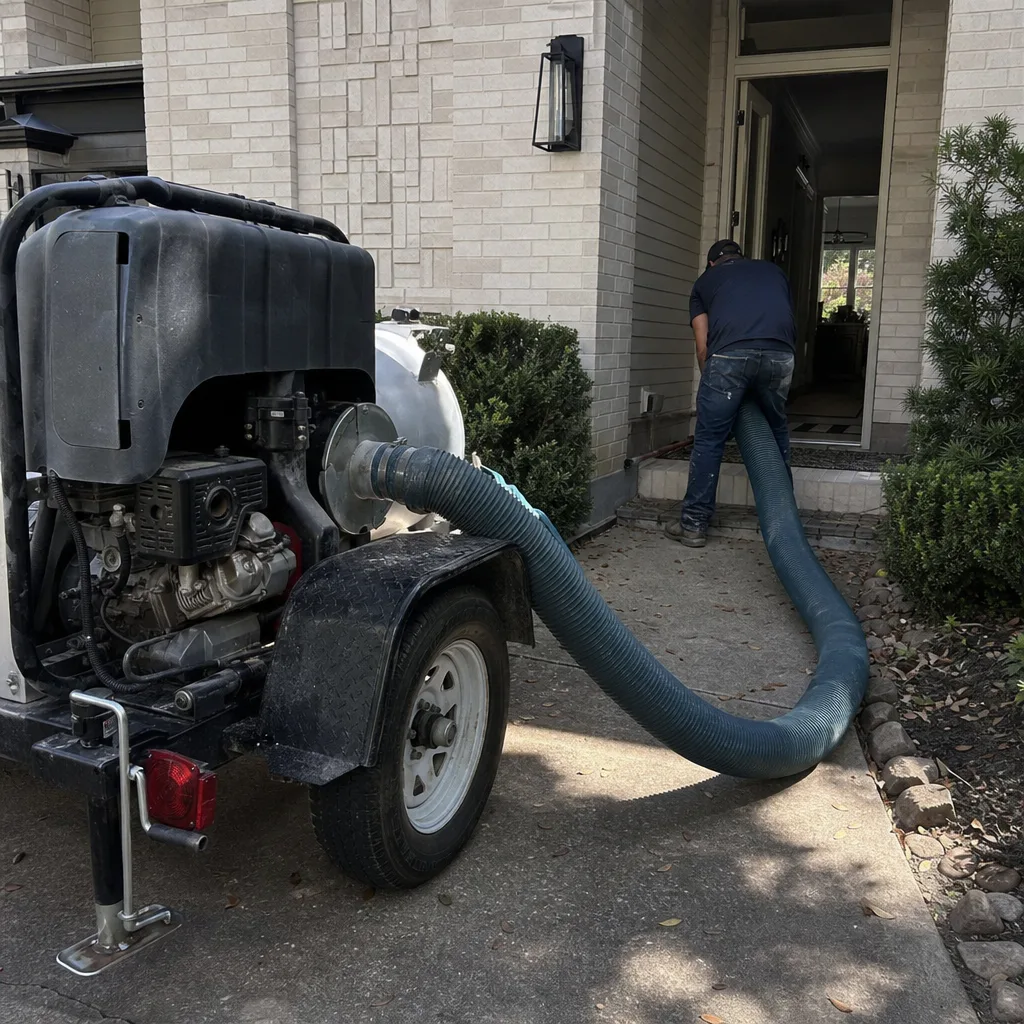
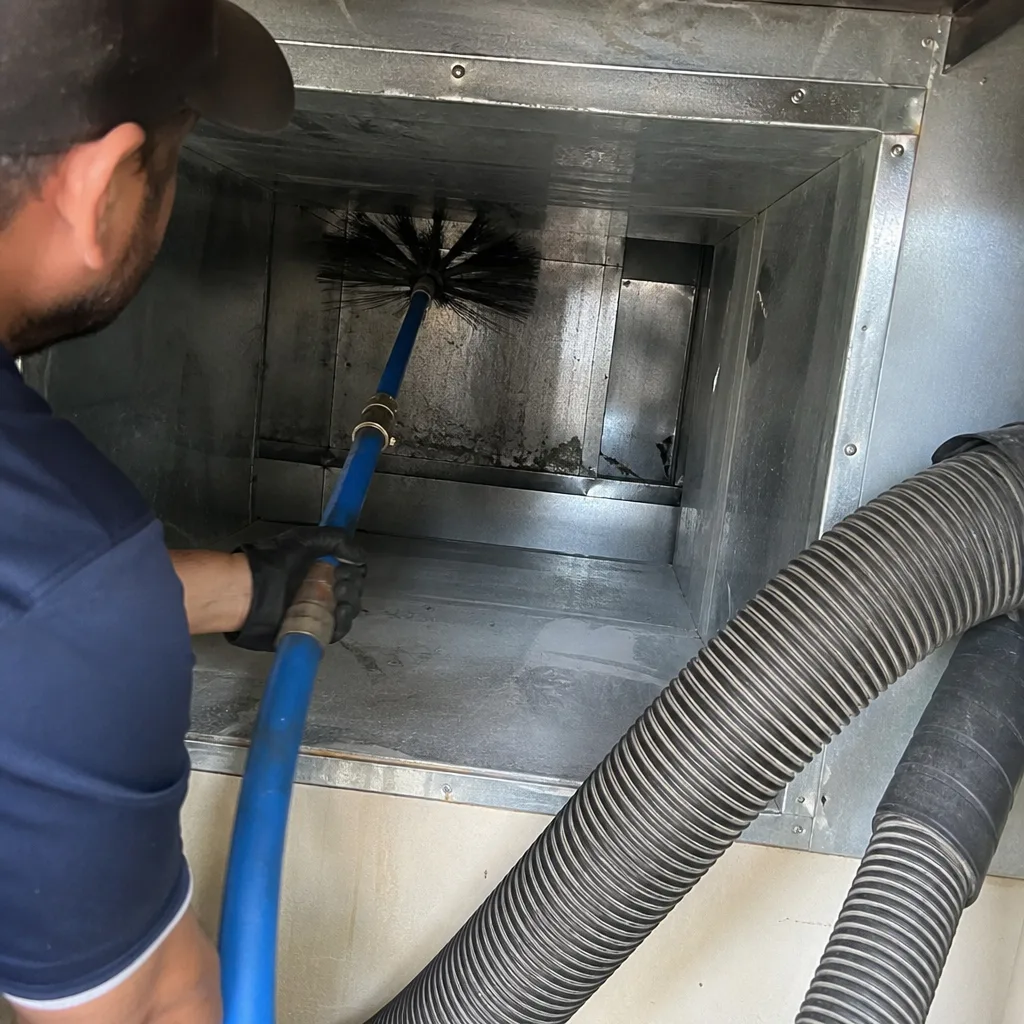
Professional air duct cleaning operates on negative-pressure source removal. Here’s what that means in plain terms: a large vacuum, typically mounted on a truck or as a portable unit like the Nikro HP20 or Abatement Technologies PREDATOR 1200, attaches to your duct system near the air handler. This creates suction throughout the entire network of duct runs. Then a technician introduces agitation devices, rotary brushes or compressed air whips, into individual registers. The agitation dislodges debris; the negative pressure carries it toward the vacuum and out of your home.
The critical element is that air moves toward the vacuum source, not away from it. This requires:
- Sufficient CFM to maintain velocity through the full length of each duct run, typically 20 to 40 feet in The Woodlands homes
- A sealed connection point at the plenum or air handler to prevent the vacuum from simply pulling conditioned air from your living space
- Agitation tools sized to the duct diameter, usually 6 to 8 inches for residential supply runs
- HEPA filtration on the vacuum exhaust to prevent redistribution of fine particulate
A consumer vacuum at a register does none of this. It pushes air into the duct, carrying surface debris past the first obstruction. It has no sealed connection, so most airflow leaks at the register face. It lacks agitation beyond what a brush on a flexible rod can reach. And standard shop-vac filtration captures particles down to about 5 microns, while professional HEPA systems capture 99.97% of particles at 0.3 microns, the size range that includes mold spores and fine pollen common in The Woodlands’ heavy tree canopy.
In our work across The Woodlands, from the established neighborhoods near Research Forest to newer developments along FM 2978, we’ve found that homes with recent DIY attempts often show a characteristic pattern: clean first 18 inches of each boot, compacted debris beyond the first elbow, and increased pressure drop across the system, measurable as reduced airflow at distant registers.
The equipment matters because the physics are non-negotiable. Rotobrush brush-and-vac systems, Nikro portable extractors, and Abatement Technologies negative-air machines are sized for this specific application. You cannot approximate their function with household tools.
The Honest Cost Comparison: DIY Attempt vs. Documented Professional Cleaning
Let’s calculate what a DIY attempt actually costs, without inflating either side.
DIY Attempt Costs
| Item | Cost | Notes |
|---|---|---|
| Register cleaning brushes and extension rods | $35-$75 | Basic kits; professional-grade rotary systems cost $300+ |
| Shop-vac with HEPA filter (rental or purchase) | $80-$250 | Standard shop-vac; true HEPA retrofit adds $40-$80 |
| Replacement filters, microfiber cloths, cleaning solution | $25-$40 | Consumables for single use |
| Time investment | 4-8 hours | First attempt for typical 2,500 sq ft The Woodlands home |
| Potential: equipment rental for rotary brush system | $150-$300/day | Specialty rental; most homeowners skip this |
| Typical total outlay | $140-$665 | Lower end: basic attempt; higher end: serious equipment rental |
Professional Cleaning Costs in The Woodlands
| Scope | Price Range | What It Includes |
|---|---|---|
| Single-system home (1 furnace/AC, up to 12 registers) | $400-$550 | Full negative-pressure extraction, all supply and return runs, plenum access, photo documentation |
| Dual-system home or larger (13-20 registers) | $550-$700 | Extended scope, additional equipment setup time |
| Additional services: dryer vent, sanitizing, sealant | $75-$200 each | Priced separately, quoted in writing before work |
The honest comparison: a basic DIY attempt costs $140-$200 and accomplishes register boot cleaning plus potential redistribution of debris deeper into the system. A serious DIY attempt with proper rotary rental approaches $500-$665, enters the professional price range, and still lacks the negative-pressure infrastructure, sealed plenum connection, and HEPA exhaust that define actual source removal.
Professional cleaning at $400-$700 includes documented photo evidence of every duct run, before and after, delivered as part of the standard job record. This is not a marketing add-on. It is how you verify that work occurred in ducts you cannot see.
For The Woodlands homeowners who purchased between 2015 and 2025, many at price points above $500,000, our How to Hire a Air Duct Cleaning Contractor in The Woodlands: A Step-by-Step Guide can help ensure the relevant calculation is not the $200 difference. It is whether the service produces verifiable results in a system that represents 15% to 20% of your home’s energy consumption and directly affects indoor air quality during eight months of continuous cooling.
The Two Scenarios Where DIY Is the Right Answer
DIY maintenance is not universally wrong. It is appropriate in specific, limited circumstances.
Scenario 1: Light Dust Accumulation Under Two Years
If your home is under two years from its last professional cleaning, or if it is a newer construction in The Woodlands with no renovation history, register boot wipe-down and faithful filter replacement may be sufficient. The debris load in a well-filtered system with no construction disturbance is primarily fine dust that settles in low-velocity zones. It has not yet formed the compacted layers that require agitation and negative pressure.
Confirm this with your phone camera inspection. If the video shows smooth metal surfaces beyond the first elbow with only light, powdery dust, maintenance-level cleaning is appropriate. Schedule a professional cleaning at the three- to five-year mark depending on filter discipline and local conditions.
Scenario 2: Post-Renovation Register Boot Cleaning
Construction dust is different from operational dust. It is heavier, more abrasive, and often contains drywall compound, sawdust, and insulation fragments. If you’ve completed a renovation and your contractor failed to seal registers, the boots and first duct sections are loaded with debris that a vacuum and damp cloth can address.
However, and this is critical, construction dust that has entered the full duct run requires professional extraction. The weight and particle size exceed what consumer equipment can transport. We’ve documented this in The Woodlands homes in Indian Springs and Cochran’s Crossing, where kitchen remodels generated enough drywall dust to form visible piles at register boots. The homeowners cleaned the boots effectively. The dust beyond the first elbow required our Nikro portable system with compressed air agitation.
In both scenarios, DIY is maintenance, not remediation. Know which you’re attempting.
The Four Scenarios Where DIY Makes the Problem Worse
There are circumstances where DIY attempts actively damage the system or create health hazards. We’ve encountered all four in The Woodlands service calls.
1. Visible or Suspected Mold
If your phone camera shows dark, irregular growth on duct surfaces, or if you smell mustiness when the system cycles, do not disturb it. Agitation without containment and negative pressure releases spores into your living space. The Woodlands’ humidity, particularly from May through October, creates conditions where mold can establish on organic debris in ductwork. Professional remediation requires containment barriers, negative air machines with HEPA filtration, and often antimicrobial application following NADCA, National Air Duct Cleaners Association, protocols.
We do not apply antimicrobial treatments without documented evidence of biological growth. Haven Standard Clause 1 requires written pricing before work; it also requires photographic documentation of conditions that justify any treatment beyond mechanical cleaning.
2. Disconnected or Damaged Duct Runs
Phone camera footage showing an open cavity, collapsed flex duct, or separated joints indicates a repair issue, not a cleaning issue. Running a brush or vacuum into a disconnected section can damage the duct further, push debris into wall or ceiling cavities, or create new leaks in the pressure boundary. In The Woodlands homes built during the 2015-2020 construction surge, we’ve found disconnected flex duct in attics where installation quality was inconsistent. This requires physical repair and sealing before any cleaning is appropriate.
3. Post-Flood Debris
Hurricane Harvey in 2017 and subsequent flooding events in The Woodlands left sediment in duct systems that DIY equipment cannot extract. Flood debris is not ordinary dust. It contains silt, potential chemical contaminants, and biological material that requires industrial-grade extraction and often duct replacement in low-lying sections. We’ve serviced homes in areas near Spring Creek and Panther Branch where floodwater entered crawl spaces and basement returns. Consumer vacuums lack the capacity and filtration for this material.
4. Degraded Fiberglass Liner
Older duct systems, and some newer ones with cost-saving specifications, have internal fiberglass liner, a soft insulation layer on the duct interior. When this liner degradates, it sheds fibers that appear as fuzzy gray material in your camera footage. Agitation accelerates degradation and releases respirable fibers. Professional assessment determines whether the liner can be cleaned, encapsulated, or if duct replacement is indicated. This is not a DIY determination.
In each scenario, the common thread is that consumer equipment lacks the containment, extraction capacity, and filtration to handle the specific hazard. Attempting it redistributes contaminants or causes physical damage that increases repair cost.
A Documented Self-Inspection Process Before You Call Anyone
Documentation protects you from upsell pressure. It also gives any legitimate contractor the information needed to quote accurately without a site visit. Here’s the process we recommend to The Woodlands homeowners, refined from thousands of service calls.
Step 1: Phone Camera Documentation
- Remove each register. Photograph the register face and the boot interior with flash.
- Extend your phone slowly into the boot and record 30 seconds of video, panning across all visible surfaces.
- Note the register location: room, floor or ceiling mount, approximate distance from the air handler if known.
- Save files with date stamp and location: “Master_Bedroom_Floor_2025_01_15.mp4”
Step 2: Filter Documentation
- Remove the current HVAC filter. Photograph the loaded face with the install date visible if you wrote it.
- Photograph the filter size printed on the frame.
- Note the date and the apparent load: light dust coating, visible debris accumulation, or heavy loading with reduced visible pleat structure.
- Install a new filter of correct size. Write the date on the frame.
Step 3: Airflow Observation
- With the system running in cooling mode, hold a tissue or light ribbon at each register.
- Note registers with noticeably weaker airflow. Mark these on a simple floor plan sketch.
- Check if weak airflow registers are distant from the air handler or on a different level. This indicates potential duct design issues or blockages, not just debris.
Step 4: Compile Your Record
Organize photos, videos, and notes in a single folder. When you contact a contractor, you can share this documentation and request a written quote based on specific observed conditions rather than a generic scope.
This documentation serves two purposes. First, it establishes baseline conditions that any post-cleaning photo record can be compared against. Second, it demonstrates to the contractor that you are an informed customer, which reduces the likelihood of unnecessary upsells. A contractor who insists on a site visit before providing any pricing, despite clear documentation of standard conditions, is not operating under transparent pricing practices.
At CleanRun Air Duct Cleaning The Woodlands home, we provide written quotes based on documentation when conditions appear standard. For the scenarios described above, mold, disconnected duct, flood debris, or liner degradation, we confirm with a brief site assessment, still at no charge, because these conditions require scope verification before pricing.
What Professional Air Duct Cleaning in The Woodlands Actually Includes
Not every service labeled “air duct cleaning” performs the same work. Here’s what a documented, accountable cleaning includes, and what you should verify before agreeing to any price.
Equipment Verification
The contractor should be able to name the equipment being used on your job. Professional-grade systems include Rotobrush brush-and-vac units for residential supply lines, Nikro portable negative-air machines for systems where truck-mounted equipment cannot access, and Abatement Technologies HEPA-filtered extractors. Ask specifically. Generic references to “commercial equipment” are insufficient.
We publish our equipment roster because customers can verify specifications independently. A Rotobrush BEAST, for example, generates 450 CFM at the vacuum head with a HEPA filter standard. A Nikro HP20 portable produces 2,000 CFM at the system connection point. These numbers mean something if you understand that consumer vacuums operate at a fraction of this capacity.
The Cleaning Sequence
- System inspection and photo documentation. Every duct run is photographed before any work begins. This is your baseline.
- Register and boot cleaning. Registers are removed and cleaned separately. Boots are vacuumed and wiped.
- Negative-pressure connection. The main trunk line or plenum is connected to the extraction equipment with a sealed fitting.
- Agitation and extraction by run. Each supply and return run is addressed individually. Agitation tools, rotary brushes or compressed air whips, dislodge debris while negative pressure carries it to the collection system.
- Plenum and air handler access cleaning. The plenum, where all runs connect, is cleaned. If HVAC cleaning is included, coils and blower components are addressed.
- Post-cleaning photo documentation. Every run is photographed again. These images are delivered to you as part of the job record.
- System test and filter installation. The system is run to verify operation. A new filter is installed if included in scope.
Deliverables You Should Receive
- Written scope of work, signed before work begins, with fixed price
- Before-and-after photo record of every duct run, dated and labeled
- Written warranty or guarantee, specifying duration and coverage
- Invoice itemizing services performed
The Air Duct Cleaning in The Woodlands page details our specific scope and pricing structure. Every job we perform includes the documented photo record as standard, not optional, because verification is the point.
The Woodlands climate specifics matter here. Our extended cooling season means systems run more hours annually than in northern markets. The heavy tree canopy produces pollen loads that accumulate in returns. And the humidity range, 70% to 90% in summer months, affects how debris adheres to duct surfaces. Professional cleaning protocols here account for these conditions with appropriate agitation intensity and, when indicated, supplemental drying measures. See our Seasonal Air Duct Cleaning Care for The Woodlands: Year-Round Homeowner’s Guide for timing recommendations.
How to Choose a Contractor Without Getting Sold
The air duct cleaning industry in The Woodlands, as in most metro areas, includes operators who rely on $79 coupon pricing that expands dramatically once the technician is in your home. Here’s how to distinguish legitimate providers from bait-and-switch operations.
Verify These Specifics Before Scheduling
- Written price before work starts. Not an estimate range. A fixed price for a defined scope. If the contractor cannot commit to this, the final invoice is unpredictable.
- License verification. Texas requires HVAC contractors to hold a TDLR license for work on the air handler and connected components. Ask for the license number and verify at tdlr.texas.gov. Our license number is published on every page; it is not buried in a footer.
- Insurance and bonding documentation. General liability and workers’ compensation coverage should be verifiable on request, not merely claimed.
- Equipment specificity. The contractor should name brands and models, not use generic descriptors. This allows you to verify capabilities independently.
- Photo documentation commitment. Before-and-after images of every duct run should be standard, not an upsell. Ask how these are delivered and stored.
- Warranty in writing. Verbal promises of “satisfaction guaranteed” are meaningless without written terms. Our 365-Day Done Right Promise specifies that if the work is not right, we make it right, with the mechanism defined in writing on every job.
Red Flags During the Interaction
- Pressure to decide immediately, with “today only” pricing
- Refusal to provide written quote without site visit, despite standard conditions
- Per-vent pricing that escalates with “surprise” additional vents discovered
- Recommendation of sanitizing or sealant services without photographic evidence of conditions justifying them
- Technician who cannot or will not show you the inside of your ducts with a camera before proposing work
The HVAC Cleaning in The Woodlands page addresses integrated system cleaning, where ductwork and mechanical components are serviced together. This is distinct from duct-only cleaning and priced separately with its own written scope.
For Dryer Vent Cleaning in The Woodlands, the verification process is similar, though the scope is narrower and the safety implications, lint fire risk, are more immediate. We address this as a standalone service with its own photo documentation.
CleanRun Air Duct Cleaning The Woodlands offers free estimates throughout The Woodlands, including Panther Creek, Sterling Ridge, Alden Bridge, Indian Springs, Grogan’s Mill, Cochran’s Crossing, and Creekside Park. Every estimate is delivered in writing before any work begins, per Haven Standard Clause 1. We also provide a Free Second Opinion on any written estimate from another contractor, no cost, no obligation.
Common Mistakes to Avoid
- Buying a $89 duct cleaning kit and expecting source removal. These kits move surface debris around. They do not extract it from duct runs. The mechanism is physically inadequate for the task as marketed.
- Using a shop-vac without HEPA filtration on duct interiors. Standard shop-vacs exhaust fine particulate back into your living space. In The Woodlands, where pollen and mold spores are already elevated during spring and fall, this adds load rather than reducing it.
- Cleaning registers but ignoring the return system. Returns pull air from your living space and are typically more heavily loaded than supplies. DIY efforts often focus on visible supply registers while the return plenum accumulates debris unchecked.
- Attempting DIY after water intrusion without assessing duct condition. Post-flood duct systems may contain silt and biological material that requires professional handling. We’ve found compacted flood debris in The Woodlands homes near Spring Creek that homeowners attempted to vacuum, spreading contaminated material through the system.
- Accepting “mold” diagnosis without photographic evidence. Dark staining on duct metal is often dust accumulation, not biological growth. A legitimate contractor shows you the camera footage and, if mold is suspected, can arrange independent laboratory confirmation. We do not apply antimicrobial treatments without this documentation.
- Scheduling cleaning without verifying what “cleaning” includes. Some services clean only registers and boots, calling it “full system” work. Verify that the scope includes all supply runs, all return runs, and the plenum. Get this in writing.
- Ignoring filter discipline between cleanings. The most effective maintenance is also the simplest. A $15 filter changed on schedule reduces professional cleaning frequency more than any DIY brush kit.
When to Call a Professional
Call a professional when your documentation shows debris beyond the first elbow, when airflow is uneven across rooms, when you smell mustiness or see visible growth, or when it’s been more than three to five years since the last documented cleaning. For additional guidance, explore our more guides & resources. Call when your home has undergone renovation, when you’ve moved into a previously owned home with unknown maintenance history, or when you’re experiencing respiratory symptoms that correlate with system runtime.
In The Woodlands, where new construction in Creekside Park and established homes in Grogan’s Mill present different duct conditions, the decision turns on what your documentation shows, not on calendar time alone. A well-filtered home with no construction activity may extend toward the five-year mark. A home with pets, recent renovation, or filter neglect may need attention sooner.
CleanRun Air Duct Cleaning The Woodlands offers free estimates in The Woodlands. Call (346) 248-1474. You’ll speak to a live person, not a queue system. We’ll review any documentation you’ve collected, provide a written scope and fixed price before any work begins, and if you’ve received another estimate, we’ll provide a Free Second Opinion in writing.
Frequently Asked Questions
Professional air duct cleaning in The Woodlands typically ranges from $400 to $550 for a single-system home with up to 12 registers, and $550 to $700 for larger or dual-system homes. This includes full negative-pressure extraction of all supply and return runs, plenum access, and documented before-and-after photography of every duct run. Prices below this range, particularly the $79 to $149 offers common in coupon mailers, typically cover only register and boot surface cleaning, not full system extraction. Call (346) 248-1474 for a written quote based on your specific system - estimates are free.
Low quotes usually reflect limited scope. A $79 service often cleans only visible register faces and the first few inches of boots, using a portable vacuum without negative-pressure connection to the duct system. The work takes 45 minutes and leaves the actual duct runs untouched. Higher quotes from legitimate providers include full system extraction with professional negative-pressure equipment, agitation of every run, and photographic documentation. The difference is not markup; it is fundamentally different services with the same name. Always verify what “cleaning” includes in writing before comparing prices.
You should receive dated, labeled photographs of every duct run before and after cleaning, showing the interior surfaces. This is standard practice at CleanRun, included on every job since 2013. If a contractor cannot or will not provide this documentation, you have no verification mechanism. Ask specifically how photos are captured, stored, and delivered before scheduling. A contractor with proper equipment has camera systems integrated into the cleaning tools; photography is not an extra step.
For most The Woodlands homes with standard filter maintenance, every three to five years is appropriate. Homes with pets, recent renovation, or filter neglect may need more frequent service. The Woodlands’ extended cooling season and heavy tree pollen can accelerate accumulation in return systems. The correct interval for your home depends on your documentation: filter change discipline, phone camera inspections, and airflow observations. There is no universal calendar answer that applies to all systems.
Yes, with the correct equipment. A proper dryer vent cleaning kit with flexible rods and a rotary brush that attaches to a drill effectively removes lint from the transition duct and exterior termination. This is distinct from air duct cleaning; the vent run is shorter, the lint is lightweight, and the mechanism works with consumer tools. Clean the vent annually, or more frequently if drying times increase. For vents longer than 25 feet, with multiple bends, or that terminate on the roof, professional service may be safer and more effective. The Dryer Vent Cleaning in The Woodlands page details our scope for complex configurations.
Newer homes, particularly those built 2015 to 2025 in developments like Creekside Park, often have construction debris in duct systems from the build process. Drywall dust, wood particles, and insulation fragments are common findings in our initial inspections. If your home has never been cleaned post-construction, an initial service is worthwhile even at two to three years of age. After that, follow standard intervals based on filter maintenance and observed conditions. The investment in documented initial cleaning establishes baseline conditions for future maintenance decisions.
Complete the self-inspection process described in this guide: phone camera documentation of each boot, filter photos with dates, and airflow observations by room. Clear access to all registers, the air handler location, and the attic or crawl space access if applicable. Have your documentation ready to share. This preparation allows the technician to verify your observations, quote accurately if conditions match documentation, and focus work time on extraction rather than discovery. It also demonstrates that you are an informed customer, which reduces upsell pressure.
The Bottom Line
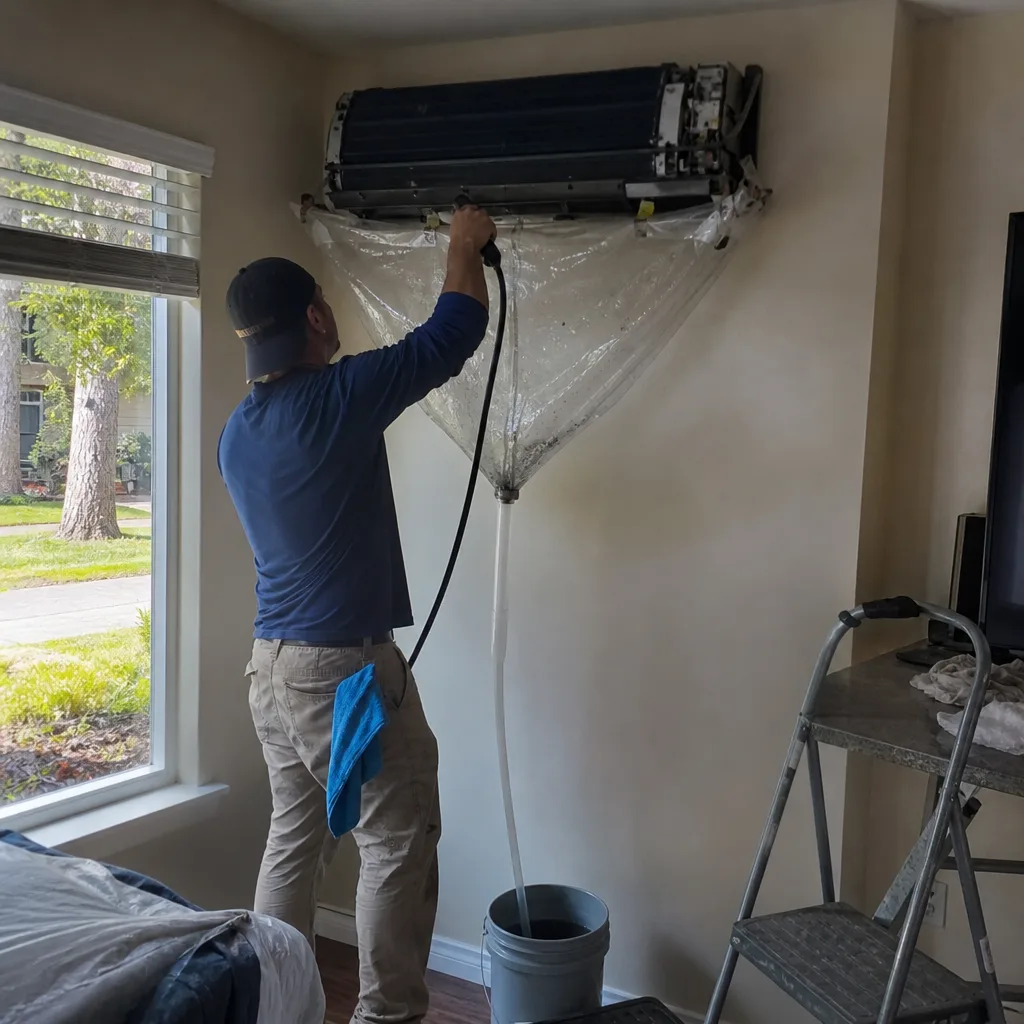
DIY air duct cleaning is real within its limits: register boots, filters, dryer vents, and visual inspection. Beyond those limits, consumer equipment redistributes debris rather than extracting it, and specific conditions, mold, disconnected ducts, flood debris, degraded liner, make DIY attempts actively harmful. The honest cost comparison shows that serious DIY approaches professional pricing without achieving professional results. For The Woodlands homeowners, the decisive factor is documentation: your own before any call, and the contractor’s photo record as proof of work performed. Choose providers who publish equipment specifics, license numbers, and written guarantees; avoid those who require phone calls for pricing or resist photographic verification. The investment in accountable, documented service protects both your indoor air quality and your budget from the industry’s prevalent bait-and-switch practices.
Written by Tomas Reyes, Owner at CleanRun Air Duct Cleaning The Woodlands, serving The Woodlands since 2013.